
Root aggression near pavement
Ficus species and peepal lift kerbs and crack service ducts within a decade. Keep them 8 m or more from pavement edges, or use root barriers and open tree pits.
9 species
Neem, arjuna, karanj, gulmohar, amaltas, ashoka, peepal and tabebuia — canopy behaviour, root aggression, pollution tolerance and median suitability for Indian roads.
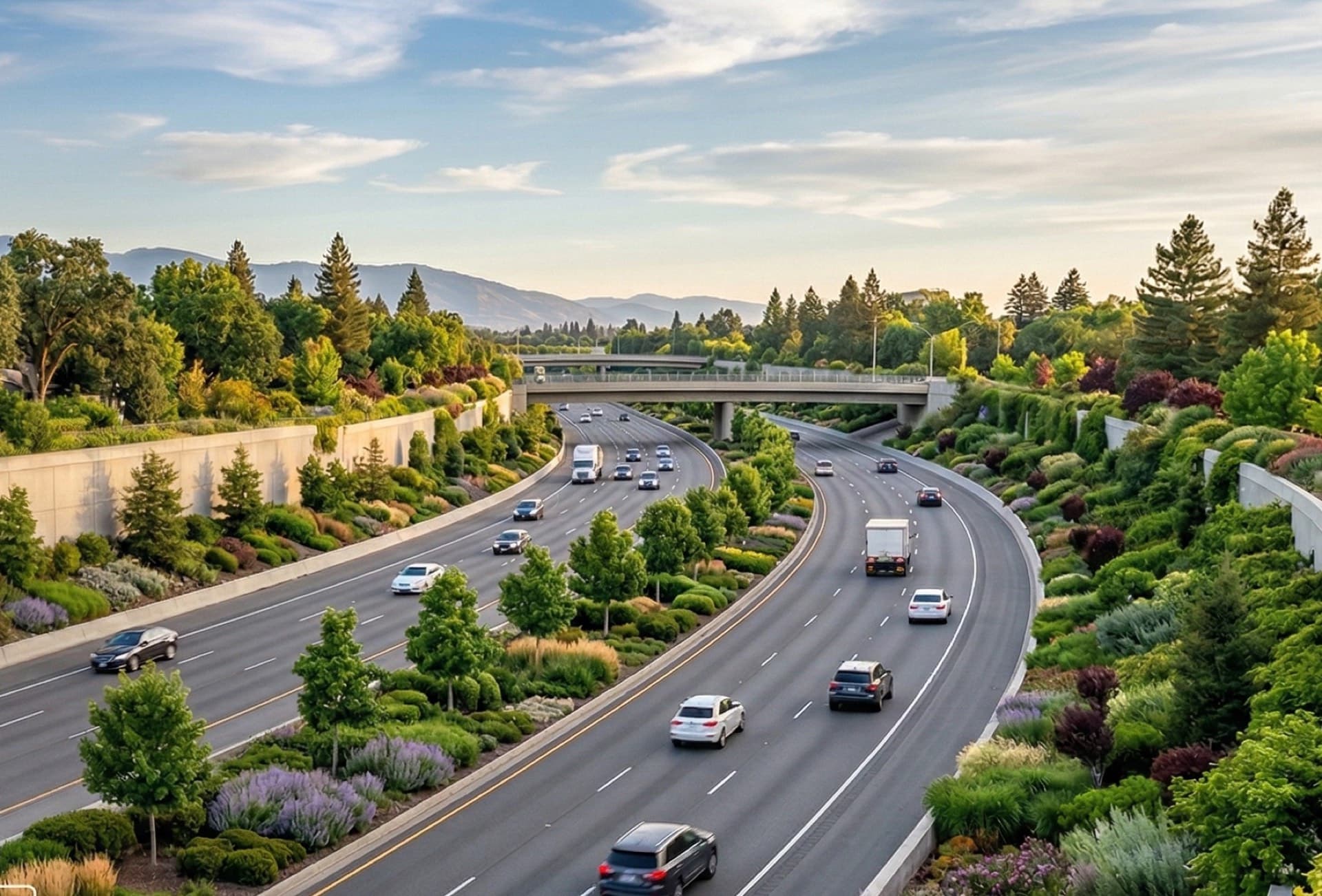
Avenue trees are the only landscape element on a road project that keeps appreciating. A correctly chosen row is a shade asset, a dust filter, a noise buffer and a heat-island intervention for the next forty years. A badly chosen row is a lifting-pavement, sight-line-blocking, branch-dropping liability that a maintenance contractor inherits.
The filters that matter on Indian corridors are root behaviour near pavement, brittleness in pre-monsoon squalls, leaf litter volume near carriageways, and whether the canopy clears the vehicle envelope without annual pollarding.
Selection
Ficus species and peepal lift kerbs and crack service ducts within a decade. Keep them 8 m or more from pavement edges, or use root barriers and open tree pits.
Gulmohar and some ornamentals shed limbs in the first heavy pre-monsoon squall. They belong in parks and set-back rows, not over live carriageways.
Specify 2.5 m clear stem minimum along footpaths and 5 m over carriageways so the first maintenance cycle is not an emergency pruning exercise.
Below 1.5 m, use shrubs only. 1.5–3 m supports small ornamental trees. Full canopy trees need 3 m plus and a soil volume that actually reaches under the kerb.
Species
Azadirachta indica
The most reliable avenue tree in India: evergreen shade, extreme drought tolerance, no serious pest problems and roots that behave near pavement.
Terminalia arjuna
A large, buttressed native with smooth pale bark and a spreading canopy — the best avenue tree for moist alignments, riverbanks and canal-side roads.
Pongamia pinnata
A dense, glossy, nitrogen-fixing shade tree that tolerates salinity, drought and coastal wind — the specialist choice for saline, sandy and coastal corridors.
Cassia fistula
The classic Indian flowering avenue tree — cascading golden racemes through the hottest weeks of the year, on a medium tree with well-behaved roots.
Delonix regia
The spectacular scarlet umbrella tree of Indian summers — fast, dramatic and structurally weak, which is why placement matters more than for any other avenue species.
Polyalthia longifolia var. pendula
The narrow evergreen column used everywhere space is tight — boundary screens, narrow medians and tight avenues where a spreading canopy is impossible.
Tabebuia rosea
The tree that turns whole streets pink for three weeks in late winter — medium-sized, well-behaved and increasingly the signature avenue tree of Bengaluru and Hyderabad.
Syzygium cumini
A dense evergreen native that holds its canopy through the hot season and supports serious urban bird life — Delhi’s classic avenue tree, with one fruit-stain caveat.
Ficus religiosa
A vast, long-lived sacred fig with unmatched canopy and biodiversity value — and roots aggressive enough that placement is a structural decision, not a landscape one.
Other categories
Send the site details, the drawings if you have them, and the maintenance budget you expect. You will get an honest read on species, timing and what the site can actually sustain.