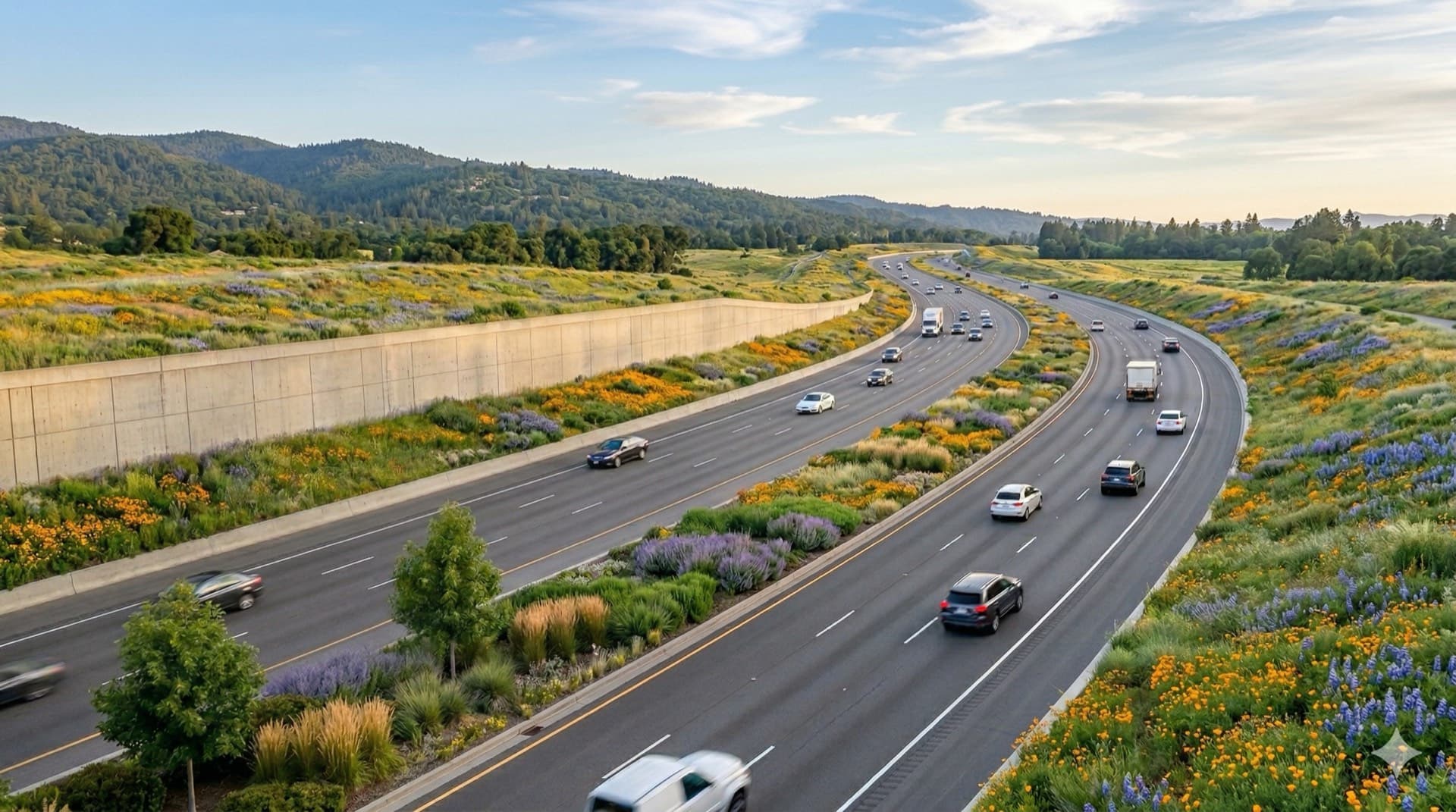
Expressway corridor with flowering median planting and landscaped embankments at sunset

Regional notes

Landscaping and Plantation in Delhi NCR

Our home region. Alkaline alluvial soil, 45 °C summers, 3 °C winter nights and one of the heaviest dust loads in the country — a combination that eliminates about half the plants Indian nurseries will happily sell you.

Covering Delhi, Noida, Greater Noida, Gurugram, Faridabad, Ghaziabad

Delhi NCR is a harder landscape environment than its plant nurseries suggest. The same site that hits 46 °C in June drops to 3 °C in late December, the soil is usually alkaline and frequently construction spoil rather than topsoil, and the dust load coats foliage for months of the year. Species selected from a coastal or southern palette will visibly fail here, usually in their first winter.

The practical consequence is that the reliable NCR palette is shorter and tougher than most drawings assume: silver date palm rather than foxtail, neem and jamun for canopy, oleander and bougainvillea for median colour, duranta and ficus panda for structure, and Selection-1 turf where people walk. Alkaline soil also rules out or complicates acid-loving ornamentals — the persistent yellowing on NCR ixora beds is iron chlorosis, not neglect.

GNIX is based in Sector 150, Noida, and much of our executed work sits in this region: NHAI corridors including the Delhi–Meerut Expressway and Eastern Peripheral Expressway, Urban Extension Road packages in Delhi, authority landscaping in Greater Noida, 10,000 sq ft of vertical garden on Noida metro stations, and private work for Omaxe, ABW Suncity, The Oberoi and Claridges.

Growing conditions

RainfallRoughly 600–800 mm, almost all of it between late June and September
TemperatureAbout 3 °C on winter nights to 45–47 °C in May and June
SoilAlluvial, often alkaline, with construction fill and compacted subgrade on most new sites
Main challengeWinter cold plus summer extremes plus dust — very few tropical species handle all three

Calendar

Planting calendar for Delhi NCR

WindowWhat to do
February–MarchBest window for shrub and hedge planting, hard pruning and lawn scarification before the heat arrives.
April–JunePlant nothing that can wait. This is an irrigation and survival period — deep watering, mulch, and shade for new stock.
July–SeptemberThe main tree and palm planting window. Establishment runs on rainfall and survival rates are highest.
October–JanuaryTurf renovation, structural pruning and seasonal colour. Avoid late-season feeding that pushes soft growth into cold nights.

Species

What performs in Delhi NCR

Recommended

  • Silver Date Palm The formal palm that survives NCR winters and summers without protection or reliable irrigation.
  • Neem Evergreen shade, extreme drought tolerance and high dust tolerance — the default NCR avenue tree.
  • Jamun Dense evergreen canopy through the hot months and the best bird value available in the region.
  • Oleander (Kaner) Nine months of flowering on medians with almost no water and full tolerance of dust.
  • Bougainvillea Colour on flyovers and embankments where irrigation is unreliable.
  • Ficus Panda Formal hedging that holds density in both full sun and building shade.

Use with caution

  • Foxtail Palm Shows cold burn most NCR winters and young palms can be killed outright in a hard December.
  • Bottle Palm Effectively an atrium plant here — damaged below 10 °C and killed by frost.
  • Ixora Chlorotic in alkaline NCR soil and hard water unless the bed is amended and mulched properly.

Local factors

What catches projects out here

Alkaline soil and hard water

Persistent yellowing with green veins on ixora, hibiscus and gardenia in NCR is almost always iron chlorosis from alkaline soil and hard irrigation water. Amend and mulch, or choose species that suit the soil rather than fighting it every season.

Dust management

On roadside and industrial sites, a quarterly foliage wash-down measurably improves plant health and appearance. It belongs in the maintenance scope in this region.

Construction fill, not topsoil

Most new NCR sites have compacted fill where the drawing assumes soil. Budget for topsoil import and subgrade breaking, or the planting fails regardless of species.

Groundwater stress

Much of NCR is over-extracted. Designs that assume unlimited borewell irrigation are increasingly untenable; hydro-zoning and rainwater harvesting are practical necessities rather than gestures.

Delhi NCR — frequently asked questions

Which trees grow best in Delhi NCR?

Neem, jamun, arjuna on moist ground, karanj on saline patches, and amaltas for flowering. All four tolerate the alkaline soil, dust and temperature range. Gulmohar performs well visually but should be kept well away from carriageways and buildings.

Which palms survive Delhi winters?

Silver date palm, Washingtonia, royal palm and Chinese fan palm all come through NCR winters. Foxtail, bottle and areca palms are cold-sensitive and either show damage or die in exposed positions.

When should you plant trees in Delhi NCR?

July to September for trees and palms, so establishment runs on monsoon rainfall. February and March suit shrubs and hedges. Avoid April to June entirely unless irrigation is guaranteed.

Working on a site in Delhi NCR?

We are based in Noida and run crews across the region. Send the site details to hello@gnix.in and we will come back with species, timing and a realistic maintenance requirement.

WhatsApp