
Chainage-wise species planning
Soil, rainfall, salinity and irrigation availability change along a corridor; the plant list should change with them. We map species by chainage rather than repeating one palette for a hundred kilometres.
Corridor execution
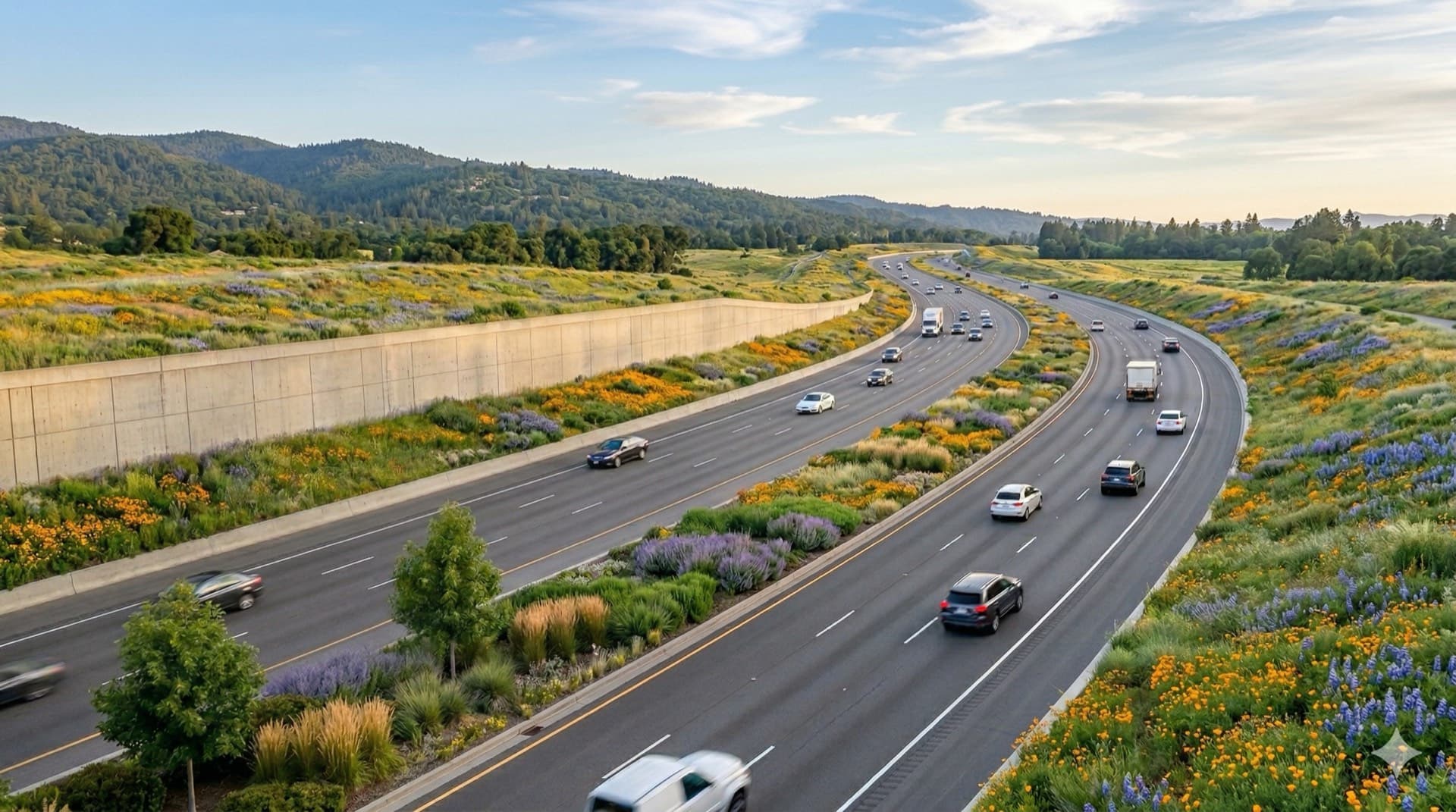
Avenue, median, embankment and interchange planting for expressway and highway packages — designed for survival at handover, not just for the drawing.
A highway plantation package is judged twice: once at the planting count, and again eighteen months later when somebody drives the corridor and counts what is still alive. Almost every failure between those two moments traces back to four decisions taken early — species against soil and rainfall, pit specification, irrigation through the first two summers, and whether anyone is genuinely responsible for the plants after the planting bill is paid.
GNIX runs corridor plantation as an execution discipline rather than a supply activity. That means chainage-wise species mapping against the soil investigation, pit and backfill specifications that survive a compacted subgrade, a water plan that assumes tanker logistics rather than a promised borewell, and a maintenance handover with a survival number attached to it.
We have delivered and maintained plantation packages on NHAI expressways including the Delhi–Meerut Expressway and the Eastern Peripheral Expressway, and are currently executing corridor packages on the Bangalore–Chennai Expressway, the Delhi–Vadodara Expressway in Rajasthan, the Raipur–Visakhapatnam Economic Corridor in Odisha and the Khammam–Devarapalli Expressway in Telangana.
| Typical avenue spacing | 8–10 m on centre, species dependent |
|---|---|
| Standard tree pit | 900 × 900 × 900 mm minimum; 1200 mm cube in compacted subgrade |
| Median shrub density | 4–9 plants per square metre depending on species and cover target |
| Vetiver slope rows | Slips at 100–150 mm centres along the contour |
| Establishment irrigation | Two full summers before a planting is considered independent |
| Reporting | Chainage-wise planting register and periodic survival audit |
Scope
Soil, rainfall, salinity and irrigation availability change along a corridor; the plant list should change with them. We map species by chainage rather than repeating one palette for a hundred kilometres.
Clear-zone compliant avenue planting with specified clear stem, pit dimensions, root-zone soil volume, staking and tree guards.
Sight-line-compliant shrub massing that holds under 1.0–1.2 m, sequenced so that colour is present in the months the corridor is most photographed.
Vetiver hedgerows along the contour, groundcover establishment and turfing on cut and fill slopes to stop erosion before it starts.
Higher-intensity landscape treatment at the points where the corridor is seen at low speed — loops, plazas and entry gateways.
Drip mains and laterals where a permanent source exists, tanker-based watering cycles where it does not, and a written schedule for the first two summers.
Method
Plant library
Each entry carries mature size, spacing, water demand, planting window and the maintenance cycle it commits you to.
Azadirachta indica
The most reliable avenue tree in India: evergreen shade, extreme drought tolerance, no serious pest problems and roots that behave near pavement.
Pongamia pinnata
A dense, glossy, nitrogen-fixing shade tree that tolerates salinity, drought and coastal wind — the specialist choice for saline, sandy and coastal corridors.
Phoenix sylvestris
India’s native date palm and the toughest formal palm available: silver-blue crown, diamond-cut trunk, indifferent to heat, drought, dust and cold.
Nerium oleander
The standard Indian median shrub: continuous flowering, near-total drought tolerance, immunity to vehicle pollution — and toxic in every part, which decides where it can go.
Bougainvillea glabra / spectabilis
The hardest-working colour plant in India: months of bract colour on almost no water, provided you resist the urge to feed and irrigate it.
Chrysopogon zizanioides
The engineering plant of Indian landscapes: a deep-rooted clumping grass that holds embankments, filters runoff and stops erosion where nothing else will grow.
Evidence
CompletedExpressway
Avenue and median plantation with maintenance on one of the most heavily used access-controlled corridors in the National Capital Region.
CompletedExpressway
Structured plantation and sustained maintenance on a major NCR bypass corridor built to divert heavy vehicle traffic around Delhi.
OngoingExpressway
A live corridor plantation package on the Bangalore–Chennai Expressway, executed for green cover, orderly upkeep and long-term survival on a fast-moving infrastructure site.
On most North, West and Central Indian corridors, neem is the primary avenue species, with karanj on saline and coastal stretches and arjuna on moist alignments. Medians take oleander, bougainvillea and tecoma; embankments take vetiver. The correct answer is always chainage-specific rather than a single list.
Outside the clear zone defined for the design speed in the applicable road standard — commonly 4.5 m or more on high-speed corridors, with additional restrictions at curves, gaps and sight triangles. Shrubs held under 1.2 m are used inside median areas where trees are not permitted.
With monsoon planting, correct pit work and funded establishment irrigation, 85–95% at the end of the defect-liability period is achievable. Packages planted outside the monsoon window with no irrigation plan routinely land below 50%.
Yes. Most of our corridor work is plantation plus maintenance, because splitting the two is the single most reliable way to lose the plants. Annual maintenance contracts can also be taken on plantations executed by others.
Read next
Highway plantation · 5 min read
A specification-grade guide to median planting: width thresholds, sight-line limits, species that survive dust and drought, planting densities and the maintenance cycle each choice commits you to.
Read the guideExecution · 5 min read
Most plantation losses are decided before planting. A practical breakdown of the six failure points — timing, stock, pits, planting depth, water and ownership — and what a defensible survival audit looks like.
Read the guidePlanning · 5 min read
The monsoon gives you roughly ten weeks of free irrigation a year. A planning guide to using it — regional windows, pre-monsoon preparation, planting sequence and what to do when the programme slips.
Read the guideRelated
Core service
Full softscape execution for campuses, townships, industrial sites and public realm — from soil and levels through planting, lawns and irrigation to a working maintenance handover.
Service detailAnnual contract
Annual maintenance contracts that keep planted assets looking deliberate — with a written calendar, defined KPIs and reporting instead of an unscheduled crew.
Service detailSpecialist operation
Moving mature trees out of the way of construction and keeping them alive — root preparation, lifting, replanting and the year of aftercare that decides the outcome.
Service detailSend the site details, the drawings if you have them, and the maintenance budget you expect. You will get an honest read on species, timing and what the site can actually sustain.