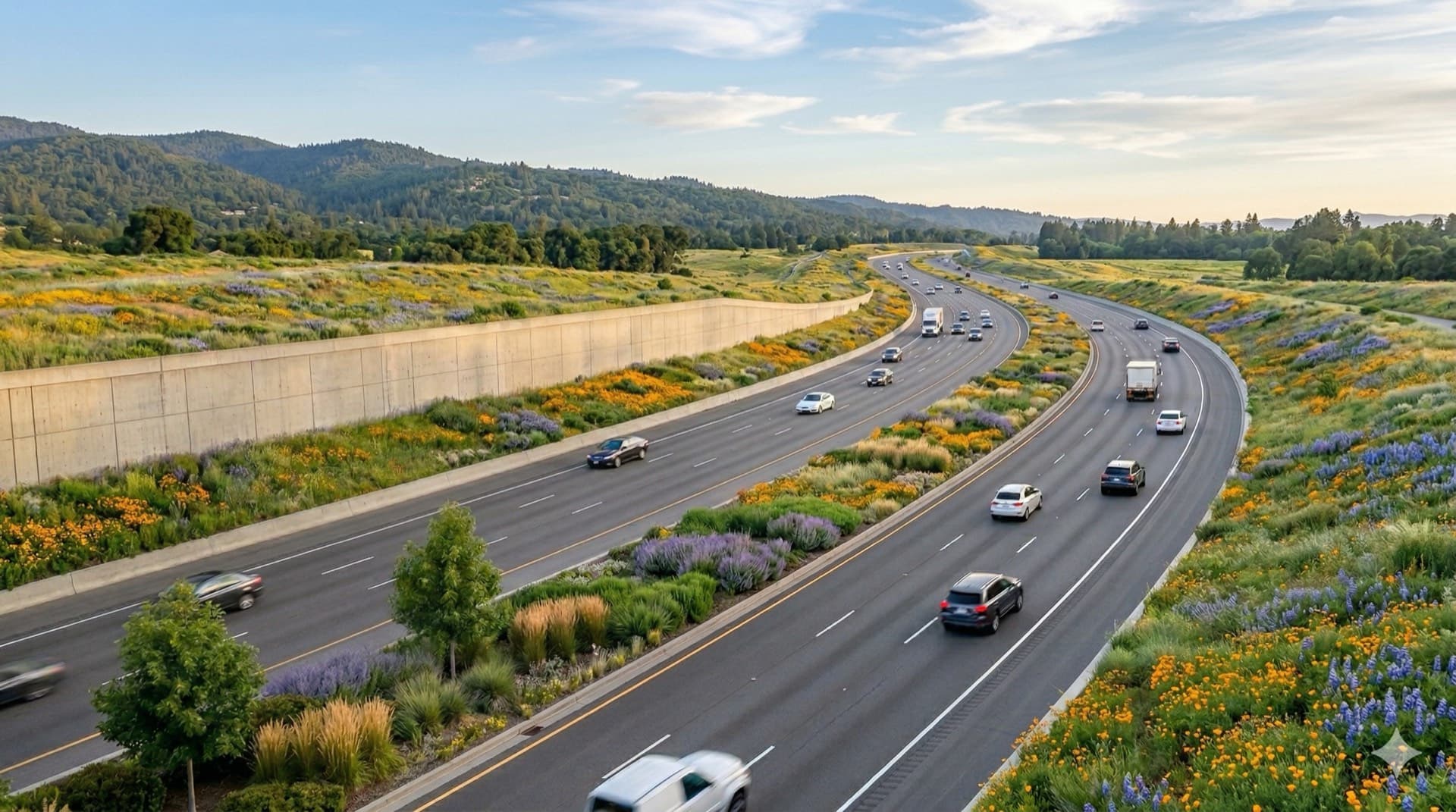
Expressway corridor with flowering median planting and landscaped embankments at sunset

Regional notes

Landscaping and Plantation in Jaipur and Rajasthan

Semi-arid design discipline. With 500–650 mm of rain and 47 °C summers, Rajasthan projects succeed by selecting for drought first and appearance second — and the results still look good.

Covering Jaipur, Udaipur, Jodhpur, Kota and Rajasthan corridors

Rajasthan projects fail when they are designed as though water will be available. It usually will not be, at least not in the quantities a conventional landscape assumes, and the summer evaporation rate is high enough that under-watering shows within days rather than weeks.

Designed correctly, the semi-arid palette is genuinely handsome: silver date palm and Washingtonia for vertical structure, neem and karanj for canopy, bougainvillea and oleander for months of colour, portulaca for ground-level heat performance, and vetiver on slopes. All of these survive on rainfall after establishment, which is the only sustainable basis for a Rajasthan landscape.

The other half of the discipline is soil. Sandy soil with little organic matter drains too fast to hold irrigation, so bed preparation, organic amendment and mulching do more for survival here than any amount of additional watering.

Growing conditions

RainfallRoughly 500–650 mm, concentrated in July and August
TemperatureWinter nights near 5 °C; summer highs of 45–47 °C with hot dry winds
SoilSandy to sandy-loam, often alkaline, low in organic matter
Main challengeExtreme evaporation and unreliable irrigation — water is the binding constraint on every decision

Calendar

Planting calendar for Jaipur

WindowWhat to do
February–MarchShrub planting and hard pruning. Mulch every bed before the heat begins — this is the highest-value task of the year.
April–JuneNo planting. Deep irrigation cycles only; shallow daily watering evaporates before it reaches roots.
July–AugustThe single planting window that matters. Trees, palms and vetiver go in with the rain.
September–JanuaryPost-monsoon planting for hardy stock, seasonal colour, and repair of any slope erosion from the monsoon.

Species

What performs in Jaipur

Recommended

  • Silver Date Palm Native to these conditions; survives 47 °C, cold nights and irrigation failure.
  • Washingtonia Palm Fast vertical height on toll plazas and entrances with almost no water after establishment.
  • Neem Survives 500 mm rainfall without irrigation and provides the only reliable hot-season shade.
  • Bougainvillea Flowers hardest exactly when everything else looks scorched.
  • Portulaca Ground-level colour on medians in peak summer, on almost no water.
  • Vetiver Holds sandy embankments against the short, violent monsoon runoff events typical of the region.

Use with caution

  • Areca Palm The highest water demand in the palm palette; browns badly in hot dry wind.
  • Hibiscus No drought reserve — drops buds and yellows within a week of a missed irrigation cycle.
  • Boston Fern Cannot hold in dry heat outdoors; interior and shaded courtyard use only.

Local factors

What catches projects out here

Mulch is not optional

A 75–100 mm mulch layer cuts evaporation from the root zone substantially in this climate. On Rajasthan sites it does more for survival than an extra irrigation cycle.

Deep and infrequent beats shallow and daily

Shallow watering in 45 °C heat evaporates before it works and trains roots to stay near the surface. Fewer, heavier cycles produce deeper roots and better survival.

Hot dry winds

The loo dries foliage faster than soil moisture can replace it. Windbreak planting on the exposed side of a site protects everything behind it.

Local work

Projects in and around Jaipur

OngoingExpressway

Delhi–Vadodara Expressway

Scale-driven avenue and roadside plantation across two packages of a major expressway corridor in Rajasthan, with maintenance discipline built into the delivery.

  • ClientExpressway package contractor
  • LocationRajasthan section
  • ScopeAvenue and roadside plantation across two packages

CompletedPrivate and hospitality

Private and hospitality portfolio

A multi-site private-sector portfolio spanning premium real estate and hospitality, covering greenery development, transplantation, drip irrigation and ongoing upkeep.

  • ClientOMAXE Ltd., ABW Suncity, The Oberoi New Delhi, Claridges Hotel New Delhi
  • LocationNoida, Gurugram, Jaipur, New Delhi
  • ScopeGreenery development, tree transplantation, drip irrigation and maintenance

Jaipur — frequently asked questions

Which plants survive in Rajasthan without irrigation?

After two establishment summers, neem, karanj, silver date palm, Washingtonia, bougainvillea, oleander and vetiver all survive on rainfall alone in most of the state. That list should form the backbone of any low-maintenance Rajasthan scheme.

Can you have a lawn in Jaipur?

Yes, but size it honestly — turf is the highest water demand on any site. Selection-1 Bermuda handles the heat best; keep the lawn to the areas people actually use and mass the rest with drought-tolerant shrubs and groundcover.

When is the planting season in Rajasthan?

July and August, with the monsoon. Post-monsoon planting of hardy stock works with irrigation; April to June planting is a waste of material.

Working on a site in Jaipur?

We are based in Noida and run crews across the region. Send the site details to hello@gnix.in and we will come back with species, timing and a realistic maintenance requirement.

WhatsApp