
Water availability along a long rural corridor
No continuous irrigation infrastructure over most chainages; establishment depends on tanker logistics and monsoon timing.
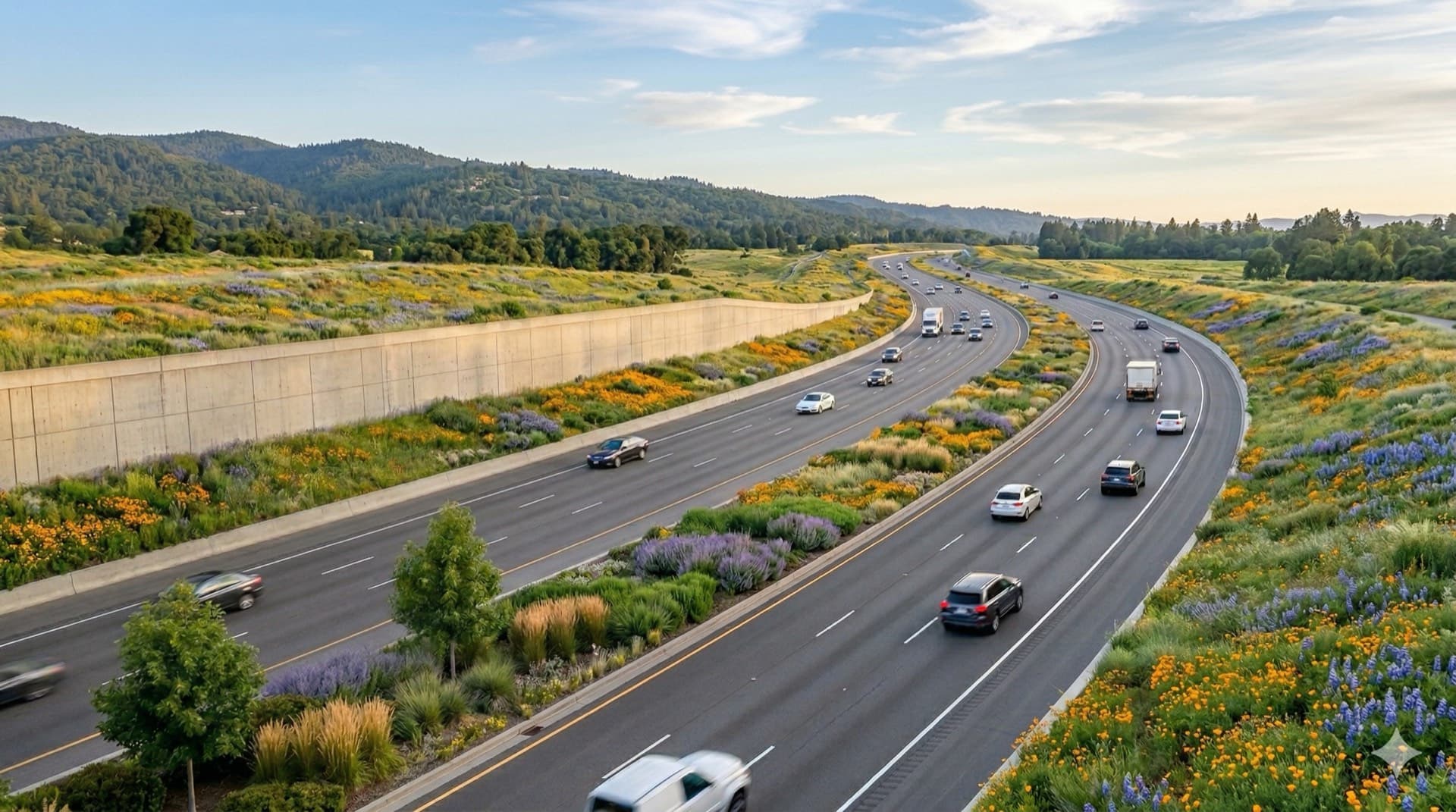
Expressway · Completed
Structured plantation and sustained maintenance on a major NCR bypass corridor built to divert heavy vehicle traffic around Delhi.
The Eastern Peripheral Expressway runs as a long ring corridor around Delhi, largely through agricultural and peri-urban land. Unlike an urban arterial, most of its length is far from any reliable water source, and maintenance visits are necessarily less frequent because the corridor is long and access points are widely spaced.
That profile changes the specification entirely: the plants must survive on rainfall after establishment, and they must look acceptable between infrequent maintenance cycles.
| Client | National Highways Authority of India |
|---|---|
| Corridor type | Peripheral ring expressway |
| Scope | Plantation and maintenance |
| Key constraint | Water access over long rural chainages |
Constraints
No continuous irrigation infrastructure over most chainages; establishment depends on tanker logistics and monsoon timing.
A species that needs quarterly shaping will be cut annually in practice. The palette has to look intentional in between.
Long fill sections erode under monsoon runoff before woody planting can establish.
Approach
Outcome
Palette
avenue trees
Azadirachta indica
The most reliable avenue tree in India: evergreen shade, extreme drought tolerance, no serious pest problems and roots that behave near pavement.
avenue trees
Pongamia pinnata
A dense, glossy, nitrogen-fixing shade tree that tolerates salinity, drought and coastal wind — the specialist choice for saline, sandy and coastal corridors.
flowering shrubs
Nerium oleander
The standard Indian median shrub: continuous flowering, near-total drought tolerance, immunity to vehicle pollution — and toxic in every part, which decides where it can go.
lawns and groundcovers
Chrysopogon zizanioides
The engineering plant of Indian landscapes: a deep-rooted clumping grass that holds embankments, filters runoff and stops erosion where nothing else will grow.
Capability
Corridor execution
Avenue, median, embankment and interchange planting for expressway and highway packages — designed for survival at handover, not just for the drawing.
Service detailAnnual contract
Annual maintenance contracts that keep planted assets looking deliberate — with a written calendar, defined KPIs and reporting instead of an unscheduled crew.
Service detailMore
CompletedExpressway
Avenue and median plantation with maintenance on one of the most heavily used access-controlled corridors in the National Capital Region.
CompletedVertical garden
Modular green walls installed and maintained across three flyovers, turning grey infrastructure surfaces into continuous planted facades.
CompletedVertical garden
Green walls on four operational DMRC metro stations, bringing planted surfaces into daily commuter infrastructure.
Send the site details, the drawings if you have them, and the maintenance budget you expect. You will get an honest read on species, timing and what the site can actually sustain.